
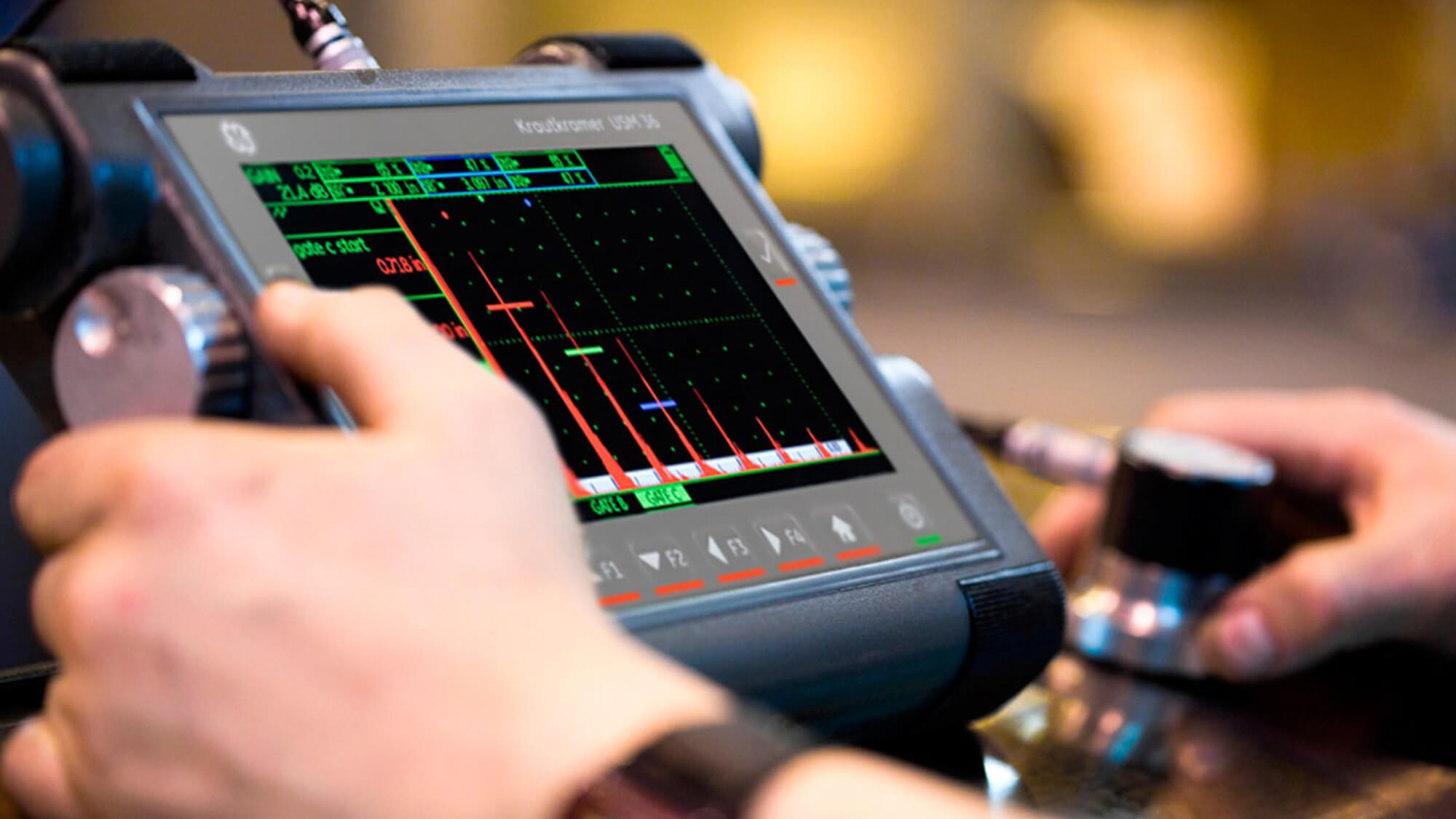
Eddy current testing is widely used in the aerospace industry and in other manufacturing and service environments that require inspection of thin metal for potential safety-related or quality-related problems. In addition to crack detection in metal sheets, eddy current can be used for certain metal thickness measurements such as identifying corrosion under aircraft skin, measuring conductivity, monitoring the effects of heat treatment, and determining the thickness of non-conductive coatings over conductive substrates.
A holiday detector is an essential instrument used to detect pinholes, cracks, and other discontinuities in protective coatings. These flaws, if left undetected, can lead to corrosion of the underlying metal surfaces. The detector applies a voltage across the coated surface and alerts the inspector when a flaw is found. It is widely used in pipeline, tank, and structural coating inspections.
A coating thickness gauge is used to measure the thickness of paint, powder coating, or other protective films applied over metal surfaces. Accurate measurement ensures that the coating meets specifications for performance, durability, and cost-efficiency. Both magnetic and eddy current principles are used depending on the substrate and coating type.
Our welding inspectors are certified under CSWIP, BGAS, or PCN standards and carry out thorough inspections on weld quality, size, and appearance. This service ensures that welds comply with engineering codes and standards, reducing the risk of structural failure and costly repairs.
Optical Emission Spectrometry (OES) is used to determine the precise chemical composition of metal alloys. The spark-based method excites atoms in the metal surface and analyzes the emitted light to identify elements present. It is ideal for PMI (Positive Material Identification) in critical applications like pressure vessels and pipelines.
Positive Material Identification (PMI) using XRF and OES ensures the correct alloy grade is used for your project. This non-destructive method helps prevent mix-ups in material supply, ensuring safety and compliance with material specifications.
This method measures the remaining wall thickness of metal components without cutting or damaging them. It is essential for monitoring corrosion, erosion, and material loss over time, especially in pipelines, pressure vessels, and structural components.
Vacuum box testing is used to detect leaks and discontinuities in welds and plate edges by creating a pressure differential. Bubbles formed in the applied soap solution under vacuum indicate a flaw. This method is especially effective for testing tank bottoms and pressure vessels.
Borescope inspection allows visual access to internal components of machinery, engines, or piping systems without disassembly. It is ideal for detecting pitting, scaling, or corrosion in hard-to-reach areas using a flexible or rigid scope with a camera.
Tank calibration ensures that the volume measurements of storage tanks are accurate. It helps maintain precise inventory control and meets legal and safety regulations. Calibration can be performed using both manual and advanced automated methods.
IRIS is an ultrasonic method used to measure wall thickness and detect corrosion in tubes and pipes. A rotating ultrasonic beam scans the internal surface, providing high-resolution data ideal for heat exchangers and boilers.
PMI is used to ensure the correct materials are used in manufacturing and fabrication. It verifies chemical composition quickly and accurately using tools like XRF and OES analyzers.
PWHT reduces residual stresses and improves the mechanical properties of welds. It is performed by heating the welded component to a specific temperature and holding it for a defined time before controlled cooling.
MFL is used to detect corrosion and pitting in steel structures. A magnetic field is applied, and leakage fields at areas of metal loss are detected with sensors, making it ideal for inspecting tanks and pipelines.
Infrared thermography detects temperature variations across surfaces to find defects like insulation gaps, electrical faults, or mechanical issues. It is a fast, non-contact method ideal for predictive maintenance.
We provide certification and testing services to qualify welding procedures and welders according to international standards. This ensures compliance and safety in critical applications.
Our training programs prepare individuals for certification in various NDT methods. Hands-on sessions, expert instructors, and compliance with ISO/ASNT standards ensure job readiness and skill validation.
Portable hardness testers allow for fast, on-site evaluation of metal hardness. Methods like rebound and ultrasonic contact impedance (UCI) offer flexibility and accuracy in field inspections.
Ensures that bolts are tightened to correct specifications for joint integrity and safety. Specialized tools measure both torque and tension to verify fastener performance.
We offer a wide range of NDT equipment for rent, including ultrasonic flaw detectors, XRF analyzers, MFL scanners, and more. Flexible rental plans and technical support ensure efficient project execution.
SA-International is a globally operating service provider delivering a broad spectrum of advanced NDT services across multiple industries, including Oil & Gas, Petrochemicals, Fertilizers, and more.
We would love to hear from you, lets get in touch
SA International© 2025 | All rights reserved.
Developed by B-Mark Digital